If you have ever been offered a brand deal, heard people talking about the latest trends, and thought, “Fine, but which one is better for me?”, you are not the only one. The short answer is that UGC vs influencer content is not a one-size-fits-all choice. Understanding the difference between creating social media posts as an influencer and producing professional user-generated content is the first step in deciding which path aligns with your creative goals.

Nick Duncan from Lit.Africa put it plainly: no creator should be picking one or the other blindly. Whether you choose the path of influencer marketing or focus on building a library of authentic assets, what pays better depends on who you are, how big your audience is, and your personal skill set. Creators today are increasingly prioritising authenticity to build trust with their communities, and once you see the clear distinction between these roles, the choice becomes much easier for those looking to boost brand awareness.
Key Takeaways
- Know the difference: Influencer marketing is about selling access to your audience and community trust, while UGC is about selling the production of high-quality content assets regardless of your follower count.
- Engagement matters more than size: Smaller creators in South Africa often have higher engagement and sentiment scores than mega-creators, making them highly valuable to brands looking for authentic connections.
- Use the right framework: Creators should choose their path based on their current audience size and production consistency; small audiences with high production skills should prioritise UGC, while large audiences with low output are better suited to traditional influencer campaigns.
- Professionalism is the currency: Brands prioritise reliability, timely delivery, and clear niche definition over follower numbers, meaning simple improvements in professional habits can drastically increase your booking rate.
What the South African creator market actually looks like
Before talking money, Nick started with the market itself. Not a global market. Not what creators in the US or Europe are reporting. South Africa.
That matters, because the numbers look different here. Based on data from more than 20,000 real South African creators on Lit.Africa, over 51% of creators earn below R10,000 a month. That does not point to a talent issue. It is a positioning issue regarding your target audience.
He also highlighted one number that explains a lot: 6,341 creators sit in the micro-influencer tier, making it the single biggest group in the market on their platform. So if you are reading this and you are a nano or micro-influencer, you are not a small exception. You are most of the market.
That matters because the influencer marketing strategy that works for a mega creator with a massive audience is not the same approach that works for someone with 2,000 followers, good lighting, and solid editing skills. Too many creators compare themselves to the wrong tier, then wonder why the advice does not work.
Nick’s point was simple. Most creators need to stop waiting until they look bigger and start using the strengths they already have. For some, that is audience trust and authenticity. For others, it is content quality. The mistake is treating all creator income as if it works the same way without having a clear content strategy to guide your growth.
UGC vs influencer content: these are two different jobs
Many creators mix these up, and even brands in South Africa often get confused. It is important to remember that influencer marketing and user-generated content are not the same thing. They represent different value propositions, and the pricing logic behind them differs as well.
In influencer marketing, a brand pays you to post content to your own audience. They are purchasing access to your followers, your credibility, and your reach. In this model, your follower count is significant because your community is part of what the brand is paying for.
User-generated content is different. When a brand pays for user-generated content, they are buying the asset itself. This might be a 30-second product demo, a lifestyle clip, or a talking-head testimonial. You film it and deliver the file, and the brand gains full content ownership. They then decide on the specific usage rights, often choosing to use the footage on their own social media platforms, websites, or as paid advertisements.
 The significant shift here is that your audience size is irrelevant to the brand. UGC creators with 500 followers can often charge the same as a creator with 50,000 followers for the same brief, provided the quality of the work is high.
In influencer marketing, your audience is the product. In user-generated content, your production skills are the product.
Here is the difference in one view:
| Model | What the brand is buying | What drives your rate | Does follower count matter? | Where the value sits |
|---|---|---|---|---|
| Influencer marketing | Access to your audience, reach, and social proof | Audience size, engagement, niche fit | Yes | Your community |
| UGC | The content asset itself | Content quality, delivery, and consistency | No | Your production skills |
Why engagement rate beats follower count
Nick made a strong point here, and it is one that a lot of smaller creators need to hear. The number you are probably underusing in brand conversations is not your follower count. It is your engagement rates.
According to Lit.Africa’s data, mega creators with a million-plus followers sit at around 7% engagement. Micro-influencers, those under 10,000 followers, sit at 11% engagement, which is the highest of any tier in South Africa.
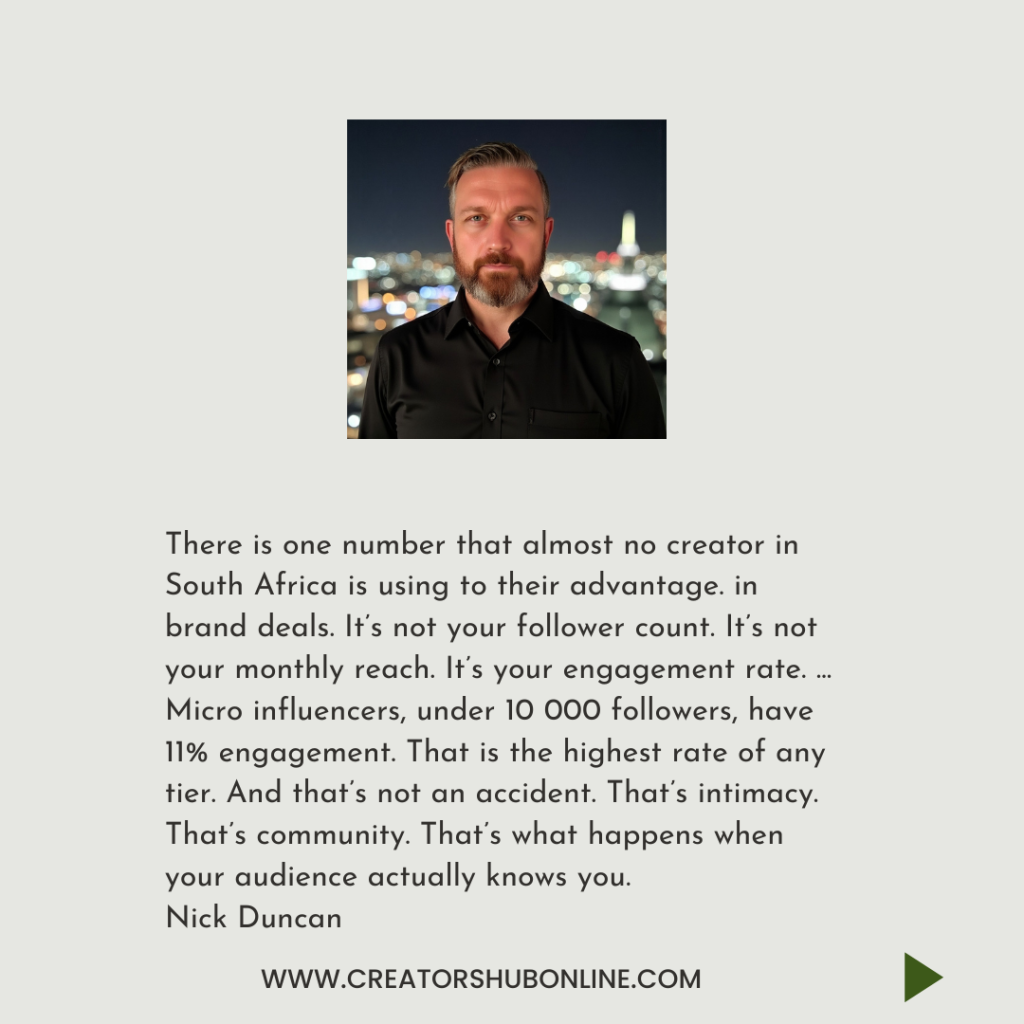
“And that’s not an accident. That’s intimacy. That’s community. That’s what happens when your audience actually knows you.” said Nick.
The same pattern shows up in sentiment. Nano creators see around 93% positive sentiment on posts, whilst mega creators sit closer to 75%. In plain terms, smaller audiences often trust creators more because of the inherent authenticity of their content. The smaller you are, the more likely people are to feel that what you say still sounds personal, not transactional.
So if a brand asks why they should pay you when you have only got 3,000 followers, the answer is not to apologise for being small. The answer is to show your engagement rates and demonstrate how your audience responds, providing the social proof brands need to justify the investment.
That said, engagement does not solve everything. It helps smaller creators win influencer deals, but it does not remove the built-in limits of influencer income. There is still a ceiling when your model depends on being chosen for occasional campaigns.
That is where UGC starts to make a lot more sense.
The framework for choosing the right path
Nick shared a framework that makes this decision much less emotional. It uses two things: your audience size and your production consistency.
Where you sit on that grid tells you what to prioritise.
| Audience and output | Best path | Why |
|---|---|---|
| Small audience, strong production | UGC first | You can earn from your skills whilst your audience grows |
| Large audience, strong production | Both | You can take influencer partnerships and keep UGC as steady income |
| Small audience, inconsistent content | Neither, yet | Spend time improving quality and consistency first |
| Large audience, low output | Influencer partnerships | Your trust and community are your strongest assets |
If you are in the small audience, strong production category, Nick was clear: start with UGC. This is probably the most common creator profile in the room, and it makes sense. Plenty of UGC creators already know how to shoot, edit, style, frame, and speak on camera. What they do not have yet is a large audience. UGC lets them monetise the skill before the audience catches up.
If you are large audience, strong production, you have hit the sweet spot. You can take influencer partnerships for campaign income and brand credibility, then keep UGC running in the background as a more consistent revenue stream. That is how you start building a creative business, rather than only a side hustle.
If you are small audience, inconsistent content, the honest answer is harder to hear. Do not pitch brands yet. A weak campaign can damage your profile and provide a poor ROI for the brand. Spend 90 days improving the basics, including lighting, consistency, output, and quality, to refine your content strategy. Once you have built that foundation, you can return to pitching.
If you are large audience, low output, influencer partnerships are the natural fit. Your community already trusts you, and that is what the brand is buying to fill the conversion stage of their marketing funnel. In that case, engagement rate becomes the primary metric you sell.
For most South African creators, the real takeaway was this: statistically, many sit in the top-left or bottom-left of the framework. That means UGC is often the fastest route to income right now, not later.
The honest pros and cons of each model
Both paths can work. Both come with trade-offs. And Nick did not sugar-coat either one.
Influencer marketing deals can pay well, but the income is patchy
The upside of influencer marketing is obvious. If you have built trust with your audience, a brand can pay well for access to that trust. This is where your personal brand, your niche, and your relationship with followers turn into commercial value.
The problem is consistency. Nick’s point here landed hard because it is true for so many creators.
You cannot build a business on income that arrives three times a year at random.
That is the structural weakness in influencer income. Campaigns can be sporadic. One month is busy, the next is quiet. You cannot plan rent, savings, or investment properly when your income arrives in bursts.
There is also the trust cost. Every time you accept influencer partnerships that do not fit your niche, you spend a little of the trust you have built. Your audience might forgive one or two off-brand posts on various social media platforms, but they will not forgive ten. If too much of your feed starts to feel rented out, people move on.
UGC is more stackable, but you don’t get the spotlight
User-generated content solves a different problem. You do not need thousands of followers to take a brief. A strong portfolio video and a good pitch can be enough to get started.
That makes user-generated content one of the few models in the creator space where income can scale with effort. You can take multiple briefs at once, improve your turnaround, and build repeat work. Because you are creating video assets for a brand to use as ads rather than relying on your own feed, your content distribution is not held hostage by the algorithm.
Nick also pointed out that most creators are more ready for this work than they think. In Lit.Africa’s surveys, 73% of South African creators already have dedicated lighting. The equipment is often there. The gap is using it properly and packaging the skill clearly.
The downside is visibility. If you have built a personal brand and care a lot about being seen, this path can be frustrating. You are often a ghost in the final product. The brand uses the content, the ad runs on social media platforms, the campaign performs, and your name might never appear anywhere.
Outside South Africa, creator pricing is messy too. This UGC and influencer pricing guide shows how wide the range can be. Nick’s point still stands though: in South Africa, the better-paying option depends on your position, not somebody else’s headline rate.
What gets brands to choose you
Once the difference between UGC and influencer work is clear, the next question is obvious: why do some creators keep getting booked whilst others don’t?
Nick’s answer was blunt. Brands are not only looking at follower counts. They are looking at the authenticity of how people respond to your content. On Lit.Africa, engagement rates are shown first, and follower count is pushed into the background. That tells you what smart brands care about when they want to drive real results.
But stats alone won’t save a confused profile. Nick described creators who post fashion on Monday, food on Tuesday, motivation on Wednesday, and travel on Thursday, then wonder why brands pass them by. If you do not have a clearly defined target audience, a brand will struggle to understand your value. Pick a lane first to master your craft and expand later.
Professionalism is the hidden differentiator. Brands talk to each other. If you are late, ignore the brief, disappear mid-campaign, or submit content that does not answer the ask, that reputation gets around. If you are early, clear, easy to work with, and reliable, you get remembered. Furthermore, including testimonials from previous clients in your portfolio acts as social proof, showing brands that you are capable of boosting their brand awareness consistently.
The biggest complaint Nick hears from brands using the platform is not bad content. It is late delivery and ghosting. That is important because it means one of the biggest barriers to repeat work is fixable.
Three things make you brand-ready:
- You deliver on time.
- Your niche and target audience are clear.
- You are easy to work with.
If you are already pitching yourself, what to include in your influencer media kit becomes part of that professionalism too. A clean kit tells brands what you do, who you reach, and how to work with you.
Why more brands are putting money into UGC
Nick also said something the industry does not say loudly enough: brands are moving budget away from big influencer deals and into paid ads that utilise high-quality user-generated content.
The reason is not complicated. User-generated content often outperforms traditional studio creative in paid ads, costs less per asset, and feels more authentic to audiences. Because brands are prioritising conversion rates and performance marketing, they want volume and variety. They want creators who can turn around briefs consistently to support every stage of the marketing funnel.
That opens the door wide for nano and micro creators. If you can deliver a product demo, a lifestyle clip, or a testimonial that looks natural and drives sales, you do not need to wait for a big audience before you start earning.
This lines up with a wider pattern in this comparison of UGC and influencers, which shows why brands use these assets when they need ad creative at scale.
For creators, that shift matters because it changes the entry point. You no longer have to treat follower growth as the only road to income. For plenty of people, follower growth can happen in the background whilst creating content pays the bills upfront.
How Lit.Africa fits into all of this
A lot of creators have the same complaint: “I don’t know how to find brand deals.” Nick said he hears that all the time, and Lit.Africa is built to solve that problem.
Creators can build a searchable profile that brands and agencies use to filter by niche, city, tier, and platform. Instead of spending all your time chasing people, the platform improves content distribution so that brands can find you directly.
Both influencer partnerships and briefs for UGC creators are posted on the platform with structured requirements, clear deliverables, timelines, and payment details. Whether a brand is managing a routine campaign or a high-stakes product launch, you can apply, get selected, and deliver work through a professional process. There is still communication, of course, but there is less mystery around what the job is and what it pays.
The platform also publishes quarterly benchmark data for creators. Nick said the data used throughout the talk is published free on Lit.Africa, including the Q1 2026 benchmark release. This includes specific insights into user-generated content, which is useful because pricing is where many creators freeze. They often struggle to know if their rates are too low, too high, or positioned correctly for the market.
Lit.Africa also helps creators sense-check their pricing. The final decision stays with the creator, but the goal is to avoid undercharging and avoid pricing yourself out of a contract without a real reason.
His closing practical tip was simple and strong. Check the engagement rate on your recent posts. Better yet, look at your last 20 posts, remove the weird outliers, and work from the numbers that reflect your normal performance and true audience reach. That is the figure you should take into any brand conversation.
Frequently Asked Questions
Can I do both UGC and influencer work at the same time?
Yes, many successful creators run both models simultaneously. You can accept influencer partnerships when you have a campaign that fits your niche, while maintaining a steady stream of UGC projects to ensure consistent monthly income.
Do I need a professional studio to create UGC?
Not at all. Most brands are looking for natural, relatable content that feels authentic to social media, which can be produced with just a smartphone and good lighting. In fact, 73% of South African creators already possess the necessary equipment to get started.
Does my follower count matter for UGC pricing?
No, your follower count is largely irrelevant for UGC projects. Brands are paying for your ability to shoot, edit, and deliver a high-quality asset for their own marketing, so your rate is determined by your production quality rather than the size of your following.
Why are brands moving budget toward UGC?
Brands are shifting focus to performance marketing, which requires high volumes of creative assets that feel authentic to users. UGC often outperforms polished, high-budget studio ads and costs less to produce, providing a better return on investment for the brand.
Final thoughts
The definitive answer to the UGC vs influencer content question is not that one always pays more than the other. Instead, the most effective path depends entirely on your position within the marketing funnel and your current creative focus.
If you have built significant audience trust, influencer marketing deals can offer exceptional ROI because brands are paying for access to your established community. However, if you possess strong content creation skills but currently maintain a smaller following, user-generated content may represent your fastest route to consistent income. The smartest creators do not simply guess which way to turn. They choose the model that aligns with their current position, then show up reliably to deliver value.
If you are still unsure which path to lead with, start by evaluating your performance metrics and your output capacity. Your engagement rate tells one part of the story, while your content quality tells the rest. Whether you choose to specialise in UGC or focus on growing your profile as an influencer, success comes down to understanding the specific needs of the brands you work with.
Related posts:
Want to be a UGC Creator? This guide gives you the plan.
This video is an extract from the Creators Hub Online Summit. You can view the rest of the speakers here.
Find out more about Lit.Africa




[…] with figures backed up by the 20 000 creators on their platform, which really shows you the difference between UGC and Influencer content, and how you can actually leverage both to your […]